Compliant. Planned before a single sensor goes up.
Many non-residential buildings need automatic lighting control by 31 December 2029. We check whether you are affected, plan your sensors in 3D and prove the savings.
Is your warehouse lit for nobody right now?
Germany's Building Modernisation Act (GModG) puts an end to that. The good news: you usually don't need new luminaires.
Rated output of the heating, air-conditioning or combined ventilation system, counted per system.
Deadline for automatic lighting control, as a rule zoned and with occupancy detection.
What is required is control. LED luminaires with a dimmable driver (0-10 V or DALI) can be retrofitted wirelessly.
As of November 2026 · Source: BGBl. 2026 I No. 226 · general information, not legal advice
Light only where someone is.
Sensors detect people and forklifts. Luminaires in that zone go to full output, all others stay at a low background level. Move your mouse or finger across the hall.
Simplified illustration. Real planning uses the manufacturers' detection diagrams.
See it first. Then install.
Your floor plan becomes a 3D model of your building. You see the light running ahead of the forklift before a single sensor is mounted.
- Detection areas from manufacturer diagrams, not rule-of-thumb radii
- Zones, background light and daylight defined in advance
- No sensor too many, no dark corner
Check. Plan. Prove.
From your first question to evidence that the obligation is met and the system pays off.
Check
Find out in 60 seconds whether § 56 applies to your building, by when, and what is required.
Start the check →Plan
Sensors, zones and background light planned in 3D, from your floor plan and a photo of the driver label.
See 3D planning →Prove
Monitoring is always included: consumption per zone and proof of savings for owners, auditors or ESG reports.
How verification works →One contract. Savings in black and white.
Many operators don't want to deal with re-adjusting settings. With the maintenance contract, we take care of it. Invest once, then it runs.
See service & proof- Remote maintenance and adjustment of settings
- Device replacement included (exceptions set out in the contract)
- Regular savings report from the monitoring
- You keep the app and stay in full control
Retrofit instead of rebuild.
No new luminaires
We make your existing LED luminaires smart. Sensor on the luminaire, done.
No new cables
Sensors talk to each other wirelessly (Bluetooth Mesh). Installation during operation.
Monitoring included
Every project includes occupancy detection, zoning and monitoring. Data goes to your building automation via BACnet/IP.
Planned for your building.
Warehouse & logistics
Light that runs ahead of the forklift. Background light in empty aisles.
Learn more →Manufacturing
Full light at the workstation, use daylight, dim ancillary areas.
Learn more →Office
Light by occupancy and daylight, also with hybrid working.
Learn more →Retail
Bright sales floor, storage and back rooms on demand, schedules per store.
Learn more →Car parks
Background light in empty lanes, full light on movement, astro clock for open decks.
Learn more →Cold storage
Light only when occupied, less heat in the cold room, sensors down to −30 °C.
Learn more →Schools & sports halls
Presence and daylight in classrooms, hall sections separately, schedules for evening use.
Learn more →Healthcare
Dimmed background light in corridors at night, presence in side rooms, local control.
Learn more →Public buildings
Portfolio check per building, monitoring for energy reporting, energy certificates from 2027 in view.
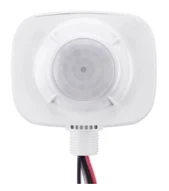
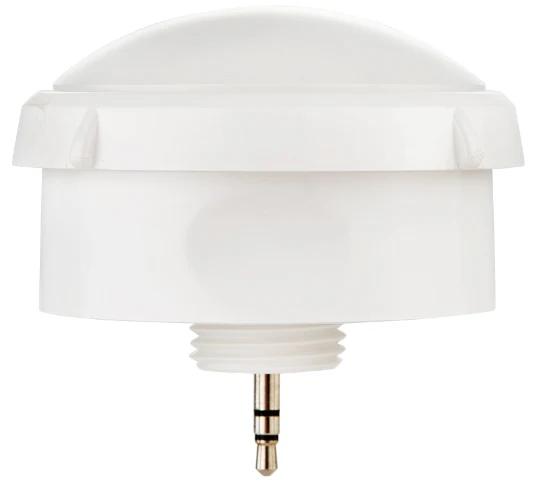
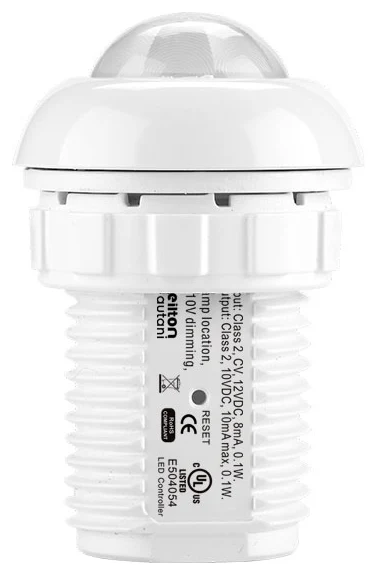
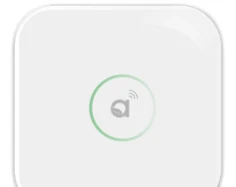
Learn more →Sensors for every mounting height.
From offices at 2.5 m to halls at 15 m.
Clear answers instead of legal fog.
Every page starts with the short answer, cites its source and carries a review date.
GModG exemption: when is lighting control unreasonable?
When does the German lighting control duty under Section 56 GModG not apply? Technical impossibility, economic unreasonableness, a worked example and documents.
Read →The 70 kW threshold in Germany: is your building affected?
When does the 70 kW threshold in Section 56 GModG apply? What counts per system, when outputs are added, who is responsible, plus a quick check with examples.
Read →DALI, KNX or wireless lighting control: which one fits?
DALI, KNX, wireless or 0-10 V compared: cabling, cost drivers, BACnet integration, vendor lock-in and scalability, with a decision guide for existing buildings.
Read →Lighting control savings: how to calculate and verify them
How to calculate and verify lighting control savings: reference consumption, multiplying factors, LBNL values, a worked example and before/after measurement.
Read →EnEfG and EED: energy audits, implementation plans and lighting
German EnEfG and EU EED duties: energy management above 7.5 GWh, implementation plans above 2.5 GWh, status of bill 21/8027 and where lighting control fits.
Read →Energy certificates for non-residential buildings from 2027
German energy certificates for non-residential buildings from 1 Jan 2027: demand-based certificate for sale and letting, classes A–G and why lighting counts.
Read →From your question to a finished plan.
Free initial consultation, one contact person.
Questions we hear every day
When does lighting control become mandatory in Germany?
Under § 56(6) GModG, non-residential buildings with a heating, air-conditioning or combined ventilation system rated above 70 kW must have automatic lighting control by 31 December 2029. It should be appropriately zoned and include occupancy detection. Our four-question check shows whether your building is affected.
Do I need new luminaires?
That depends on your luminaires. What is required is automatic control, so the LED driver must be dimmable (0-10 V or DALI). If it is, we retrofit sensors wirelessly. If it is not, or if your LED retrofit is already a few years old, new luminaires often pay off: they can be controlled and save energy through the swap alone. We supply both from a single source. A photo of the driver label is enough for a first check.
What happens if I do nothing?
The German act sets no separate fine for lighting, but the obligation still applies. It can come up in leasing, sales, financing and ESG reporting. And every hour of light for nobody costs money.
Does lighting control cover all of § 56?
No. Lighting is paragraph 6. Building automation for heating, ventilation and air conditioning under paragraph 1 is a separate part. Our monitoring supplies data to that building automation via BACnet/IP, which we coordinate with you.
What changes on 1 January 2027?
From 2027 the reference building's lighting is LED instead of fluorescent, still with presence detectors, constant-light and daylight control. That lowers the bar for new builds and renovations considerably. Non-residential buildings will only receive a demand-based energy certificate with classes A to G on sale or letting, and lighting counts towards it. From 2030 a minimum energy performance applies to existing buildings, again including lighting. All dates are in our timeline.
Does this apply outside Germany?
The EU Energy Performance of Buildings Directive (EPBD) requires automatic lighting control in all member states, in two stages above 290 kW and above 70 kW. National transposition is progressing at different speeds. See our knowledge section for the status by country.